
Fields in Marengo Tax Records
Two views work together in Marengo County property tax records. One comes from the Revenue parcel card. It lists the land itself, the owner of record on the tax roll, the value components, any exemptions, the district, and the tax due for the year. The other is the Revenue tax search. It is built for pulling a parcel by tax year rather than by ownership detail. A deed still governs when ownership itself is in dispute.
| Field | What It Shows | Where |
|---|---|---|
| Land and building totals | Components used in the appraisal | Revenue parcel card |
| Appraised value | Full appraisal figure shown for the parcel | Revenue parcel card |
| Exempt and current-use clues | Flags or land treatment affecting tax | Revenue assessment record |
| Yearly tax | Tax amount tied to the displayed year | Parcel card and tax search |
| District | The assessment district attached to the parcel | Revenue parcel card |
Appraised value and assessed value are different figures. Alabama applies a class ratio to the appraised number, and exemptions or current-use rules can further change the taxable result. The tax number on the roll is neither a sale price nor an independent appraisal.
Marengo Property Tax Calendar
The county real-property page lays out the annual cycle for Marengo County taxpayers. October 1 is when taxes become due and payable. December 31 marks the final on-time date, and anything unpaid turns delinquent on January 1. If you plan to pay by check, February 28 is the cutoff. After that, collection moves to its later stages.
| October 1 | Taxes due and payable |
|---|---|
| December 31 | Last day to pay on time |
| January 1 | Unpaid taxes become delinquent |
| March | Delinquent property advertising phase |
| May | Annual lien-auction phase, subject to the current notice |
Rely on the current county notice for live dates and payment vendors. A 2024 FAQ illustrates the process but sets no future auction calendar.
Marengo Tax Search Screen
The captured Marengo Revenue property search is the county's online tax-year entry point.
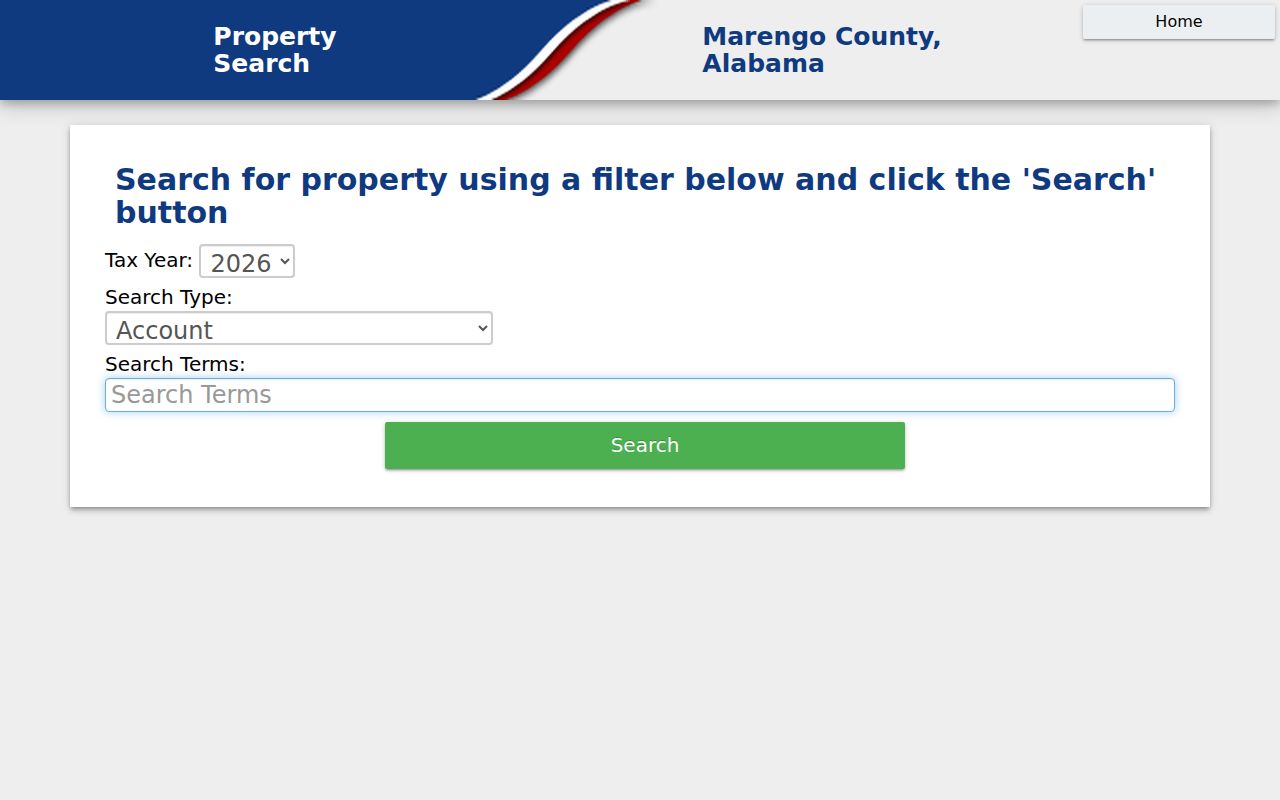
The Marengo County tax search screen works on a tax-year basis. Enter a year and the matching query terms to reach parcel-level tax details in the live results, or contact the Revenue office directly.
Marengo Assessment Class Ratios
Alabama sorts taxable property into four classes, and Marengo County applies the same ratios. Class I covers utility property at 30 percent. Class II, other property, sits at 20 percent. Class III agricultural and owner-occupied residential land gets 10 percent. Class IV private passenger vehicles carry 15 percent. For parcel research in Marengo County, the first three classes matter most. They shape what an appraisal means in context.
Never assign a class by guesswork, though. The Marengo Revenue office decides classification from the parcel record and state law. It does not go by how a property looks on a GIS map. That is why a residential parcel's appraised figure can tower over its assessed figure. Neither number equals what a buyer might actually offer for the land.
Look Up Marengo Property Tax
The Marengo Revenue property search is the county's own tool for pulling tax details on a parcel. It offers a tax year selector and a Search Type menu. There are also Search Terms, an optional Subdivision field, and a Search button. The notice on the page tells you to choose 2026 for appraised value and estimated taxes that begin October 1, 2026. Search results vary with the parcel. So treat the fields you get as the fields the county publishes.
- Select the year that matches the valuation or bill question.
- Enter the available owner, parcel, account, address, or subdivision clue offered by the live search type.
- Compare the result with the GIS parcel card's parcel number, owner, district, appraisal, and exemption flag.
- If a delinquency appears, confirm its status and redemption amount directly with Revenue.
- Assessed value
- The appraised value after the applicable property-class ratio.
- Appraised value
- The county's full value figure before a class ratio.
- Homestead exemption
- Qualified owner-occupied relief administered through Revenue.
- Tax lien
- A legal claim for unpaid tax; buying it does not itself transfer the land.
Current Use on Marengo Land
Marengo County grants current-use treatment to qualifying farmland, pasture, or timber stands. The land must cover at least five acres. It must be used for agriculture, livestock, or wood production. Applications are accepted year-round. Miss the December 31 deadline, though, and the treatment waits until the following year. A current-use value can land well below the fair-market figure on the same parcel. That savings is the whole point for working land.
Ownership changes complicate things. A new owner must refile current-use information with the county. The same rule applies to a name changed through deed or will. Skip that step and a fair-market assessment may apply instead. So a deed change is really a tax follow-up. It is not proof that the treatment carried over on its own. Check the deed records and the assessor's file together.
Rural parcel check. Ask Revenue whether the displayed value is fair market or current use and whether a recent deed triggered a refiling need.
Marengo Improvements and Timing
Pools, garages, barns, additions, and remodeling are the kinds of improvements county guidance singles out. These are capable of changing an appraisal. Timing matters. Work finished on or before October 1 can show up on the next tax statement. Anything completed later usually waits for the following year. So a tax card that lags behind construction is normal rather than a red flag about permits.
Manufactured homes get separate handling. When the home and land share one owner, the home can join the real-property tax roll. A home sitting on rented or other land instead follows registration and decal rules. Before assuming the land and the home sit on one tax record, confirm the status with Revenue.
Compare Marengo Tax-Year Dates
One parcel can carry several dates, and each means something different. The sample assessment card is labeled 2024. Its yearly tax line names 2025. Its Last Deed line reads August 27, 2024. The public GIS landing shows an August 10, 2025 version marker. Copy each label exactly instead of treating the whole result as current.
Checking dates pays off most after a sale. It also matters after an improvement, an exemption filing, or a current-use refiling. A deed can reach Probate before the Revenue roll catches up. The roll may lag behind the new owner of record. An improvement can also miss the October 1 assessment point and land on a later statement. Which roll and valuation notice control the question? Ask Revenue directly.
Homestead Clues in Marengo Records
The Alabama Department of Revenue defines the H-1 through H-4 homestead categories. The local Revenue office handles the application itself. An exemption flag on a card shapes the tax analysis. It does not settle who holds title. Eligibility, filing proof, and the right category all need confirmation from the office.
A deed, will, occupancy change, or manufactured-home status can shift the facts. Ask whether a fresh filing is required. Hold onto the assessment notice and the parcel card for the tax year in question. Together they give an appeal or correction request a clear base.
Marengo Delinquency and Lien Sales
The county's 2024 tax-lien FAQ describes Alabama Code §40-10-182 and Act 2018-577's lien-sale approach. The advertised list can include owner names, descriptions, delinquent years, tax, interest, penalties, and fees. Its May 2, 2024 sale and vendor details are historical examples only.
The purchaser receives a lien, not automatic ownership. Redemption runs through the Revenue Department. The example required certified funds covering delinquent amounts, interest, fees, and a $10 redemption fee. Confirm every current figure. The live auction vendor, list, bid fees, and certificate portal are not published by the county.
No instant title. A Marengo tax-lien purchase does not convey ownership merely because the bid succeeds; statutory redemption and later procedures still matter.
Appeal a Marengo Assessment
Alabama Department of Revenue guidance governs the protest route. Alabama Code §§40-3-20, 40-3-24, and 40-3-25 govern it too. A written protest must be filed within 30 days after the valuation notice. Evidence should focus on the parcel, condition, and classification. Land use and comparable facts matter too. Both bear on the assessed figure.
Contact the Marengo Revenue Commissioner promptly after a notice. Keep the notice date and proof of filing. Hold photographs, parcel facts, and other valuation evidence. An assessment appeal challenges value treatment. It does not correct a deed. It does not establish a boundary or transfer title.
Appeal window. File the written protest within 30 days after the valuation notice. Confirm the current submission method with Marengo Revenue.