
Trace Marengo County Former Owners Across Record Eras
Start with the newest deed clue on the parcel card. Work back source by source as the chain ages. Coverage varies by era, so describe the record actually inspected rather than assume one fixed imaging cutoff.
| Source | Years It Covers | Where Held | What It Shows |
|---|---|---|---|
| Probate recording index | Modern coverage; exact cutoff unconfirmed | Altags account / Probate counter | Grantor, grantee, date, type and book/page |
| Deeds | 1820–1901 catalog series | FamilySearch / Probate | Recorded conveyance text |
| General deed index | 1820–1905 catalog series | FamilySearch / Probate | Name-to-book/page bridge |
| State land records | Statehood through 1950 | Alabama SOS / ADAH | Earlier state land entries |
| Local history sources | Varies | ADAH / Demopolis library | Old names, maps and notice context |
Open the current Probate index first. It supplies the newest grantor and a book/page bridge. A county notice dated August 1, 2026 requires an online account; signup is free, and document access and purchasing happen after login. The official Marengo recording login shows the gate. When an image is missing, take the citation to the Probate counter rather than substitute a third-party owner list.
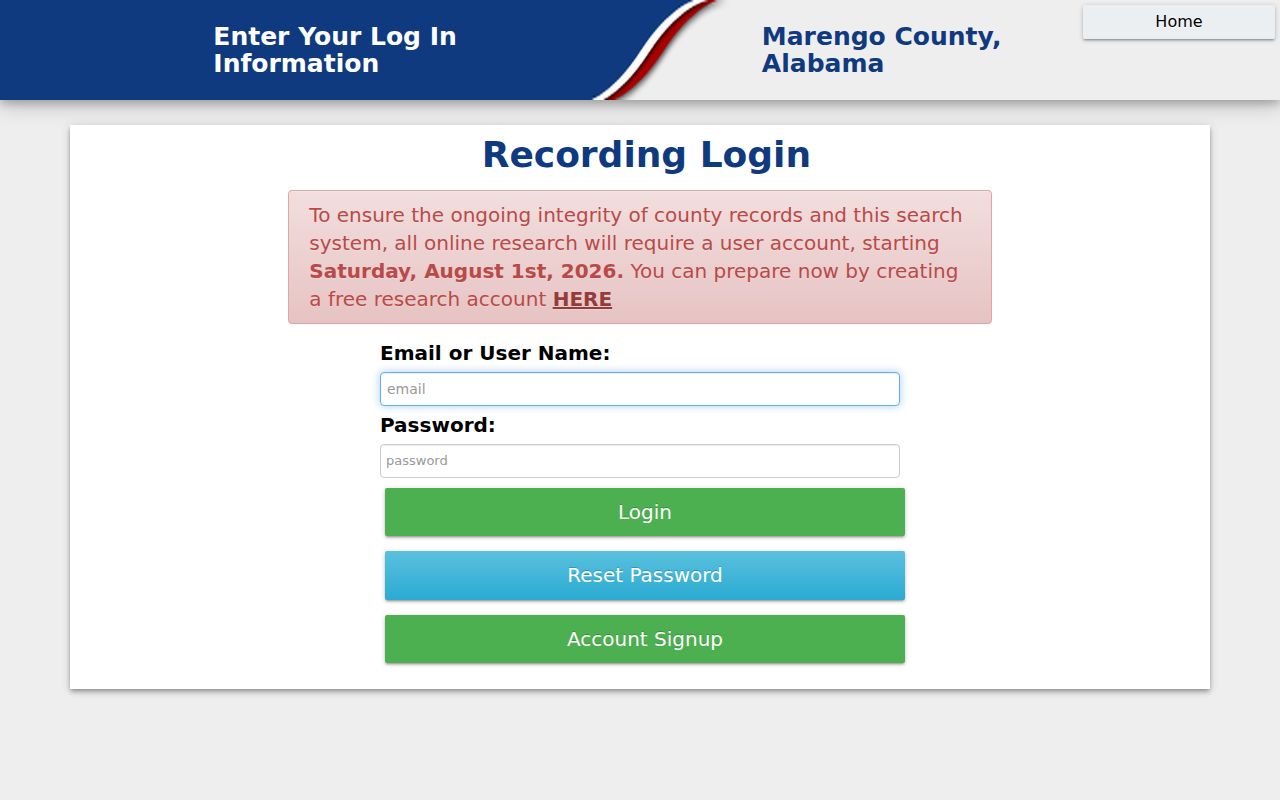
This screen proves an access rule, not full imaging.
A Marengo Card Supplies Clues, Not a Complete Timeline
A Marengo parcel card may show a Last Deed reference dated August 27, 2024, plus mapping-history rows from 2006 and 1965. Those values are strong search keys. They are not a timeline. A single row can drop a grantor. Open every mapping-history entry in the recording index or deed book, since rows may abbreviate deed types or skip transfers, before treating it as a chain link.
| Transfer date | Grantor → grantee | Instrument | Citation |
|---|---|---|---|
| Newest cited date | Read from deed image | Confirm type | Last Deed book/page |
| Earlier mapping row | Search prior owner in both roles | Do not expand abbreviations by guess | Carry exact book/page |
| Next backward step | Earlier owner → later owner | Match legal description | Record volume/page and access date |
Walk the Marengo County Deed Chain Backward
Search by name, date range, or book and page, filtering grantor, grantee, assignee, or all roles, with “Starts With” and instrument-type narrowing available. Apply those controls methodically.
- Find the newest deed by its parcel-card book/page or search the current assessment owner as grantee.
- Read the actual instrument for its grantor, grantee capacity, date and complete legal description.
- Search that grantor as an earlier grantee, using initials and name variants while holding the property description constant.
- Repeat until the online index or images stop, then carry the last reliable citation into deed books, microfilm or archival catalogs.
- Grantor / grantee
- The conveying and receiving parties named in an instrument.
- Chain of title
- The ordered series of instruments affecting the same land.
- Reverse index
- An index organized to locate an instrument through the receiving party.
- Warranty / quitclaim deed
- Different conveyance forms whose legal effect must be read from the actual document.
- Legal description
- The property identity that survives street-name and address changes.
Follow the Land When Marengo Descriptions Change
One Eastern Hills example ties Lot 2, Block B and a 70-by-150-foot description to section 32, township 18 north, range 3 east, and MAP# 1-9-32. That bridge matters. A single tract can shift between subdivision language, section-township-range clues, and a modern parcel number over its life. Match dimensions, adjoining calls, and referenced plats. A repeated surname never proves the same parcel.
The neighborhood label “N & E OF HWY 43” and an Eastern Circle address are search clues, not proven boundaries. No countywide subdivision directory exists. Pull the cited plat or deed whenever a lot and block description enters the chain.
Probate and Court Orders Can Interrupt a Neat Deed Chain
A will, probate order, guardianship, divorce decree, or corrective deed can explain why an owner never shows up in a plain buyer-seller sequence. FamilySearch catalogs Marengo wills from 1820–1936, minutes from 1820–1929, and guardians' letters from 1870–1964. Use those series to find the authority behind a transfer. Then find the deed or order. Keep representative capacity attached to the name. Executor, representative, trustee, entity: those labels mean something. A court file may explain a transfer. The exact order and any later deed must still tie back to the same legal description.
Two Courthouse Fires Require Targeted Triangulation
The Alabama archives fire list records Marengo County courthouse fires in 1848 and 1965. The 1965 blaze destroyed the 1902 courthouse and came before the 1968 replacement. Fire alone does not prove every deed was lost. Name the precise book, page, or year missing. Ask what copy or index survived. Run three alternate paths in parallel: the FamilySearch series, the ADAH Marengo finding aid with county microfilm, and Demopolis Public Library newspapers and genealogy holdings. Then return to Probate with the best citation. That beats writing “records unavailable.”
Exact Names Matter in the Marengo Index
The county's recording name-check page reveals its name-sensitive habits.
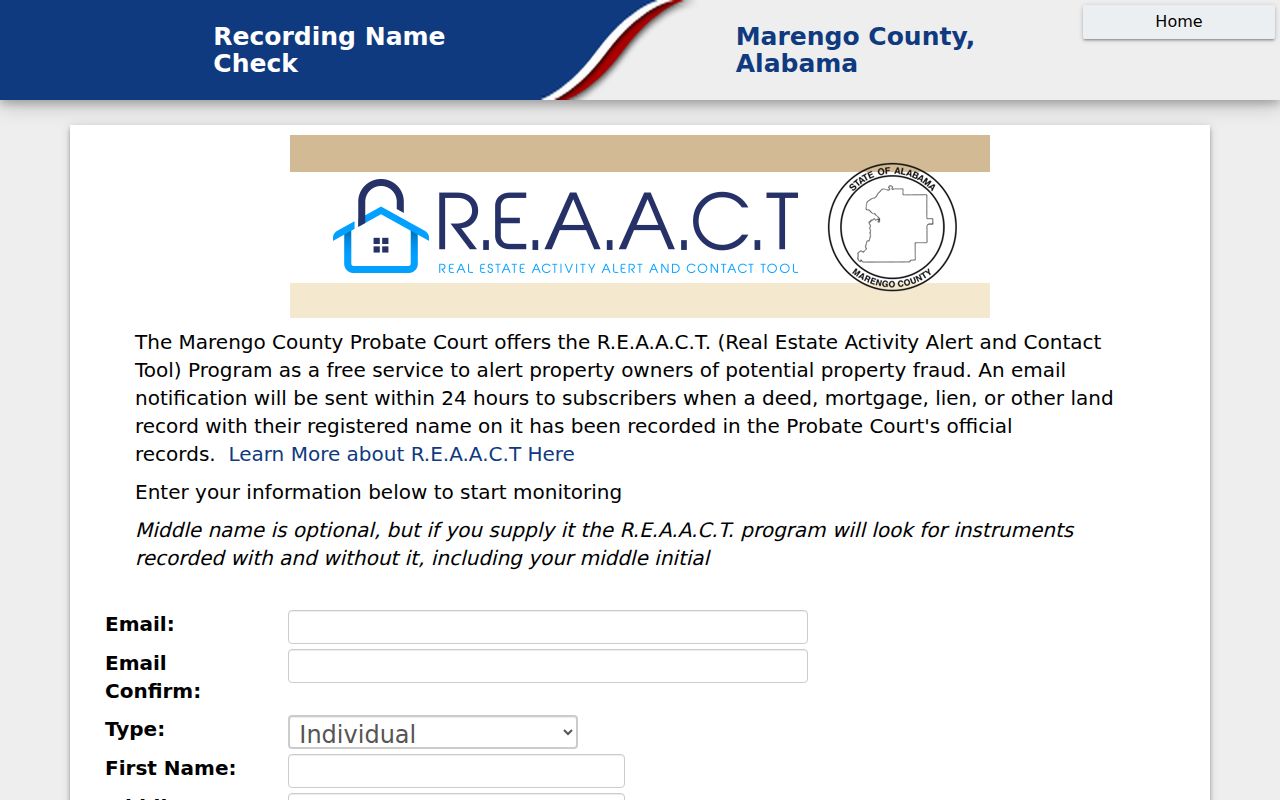
Keep initials, middle names, and representative capacity intact. Then try controlled variants, matching every candidate back to the parcel's legal description.
State and Local Collections Extend Marengo Ownership History
The Alabama Secretary of State's land-record page covers statehood through 1950 and sends post-1950 questions to county Probate. ADAH adds maps, county files, newspapers, and research-room resources. Demopolis Public Library keeps genealogy books, family histories, and microfilm with a reader/printer; copies cost 25 cents in black-and-white and 75 cents in color. These collections resolve old place names. They separate same-name owners and surface legal notices. Narrative history never substitutes for a conveyance, though. Files on Gaineswood, the Foscue-Whitfield House, or Bluff Hall can generate names and dates. The Probate instrument still controls the title.
How Far Back Marengo County Ownership Records Reach
Cataloged Marengo deed records begin in 1820. Beyond that, certainty fades. The surviving volume sequence, the online image cutoff, and the effects of each courthouse fire vary too much for one guaranteed start year. Describe the demonstrable source instead: deeds from 1820–1901, a general deed index from 1820–1905, or a named modern index result. Before 1950, state land records may add an earlier patent or state transaction. That is a starting interest, not a finished chain. After 1950, the state points to Marengo Probate. Record every unresolved jump, and seek professional title help when legal reliance matters.
Use the backward chain lawfully. Former-owner research supports house history, estate work and purchase diligence. Never use historic names or addresses to track, harass or threaten a living person.